Fill up with regular unleaded — Gasohol 91 or Gasohol 95 — at any PTT, Bangchak, Shell, or Caltex station across Phuket; these petrol brands are found island-wide, keep long opening hours, and accept both cash and cards, so refueling a rental scooter is quick and painless as long as you avoid the diesel pump and plan ahead in the quieter northern areas.
One of the first questions almost every visitor asks after picking up a scooter from Chang Thai Rentals is simple: what fuel does this thing take, and where do I put it in? It sounds trivial until you're standing at a pump in Phuket for the first time, looking at two or three nozzles with Thai labels and no idea which one is safe. This guide walks through exactly what to look for, which stations to trust, how far a tank will actually take you depending on which bike you rented, and what to do if you're caught out in a rural spot with the fuel light on. It pairs well with our guide on choosing the right bike model and our breakdown of rental prices and terms, since fuel costs and bike class go hand in hand.
What Fuel Do Rental Scooters Actually Use?
Almost every scooter and automatic motorbike in a Phuket rental fleet — including the smaller commuter models and the larger touring bikes — runs on regular unleaded petrol. In Thailand this is sold as Gasohol 91 and Gasohol 95, both blended with a small percentage of ethanol. Either grade works fine in a standard rental scooter engine; you don't need to hunt for a specific octane number or worry about mixing them between fill-ups. If you're ever unsure which grade your particular bike prefers, the fastest way to check is to ask the staff at pickup, or simply look at the fuel cap or dashboard, where many models print the recommended grade directly.
There is no need for premium or specialty fuel additives, and you should never be tempted to save a few baht by buying anything other than gasohol from a legitimate pump. The engines in the rental fleet are tuned for standard Thai gasohol, and that's genuinely all you need for the length of a typical rental period, whether that's three days or three months.
How to Identify the Right Pump
This is the part that trips up first-time riders the most, especially at bigger stations with six or eight pumps in a row. A few pointers make it foolproof:
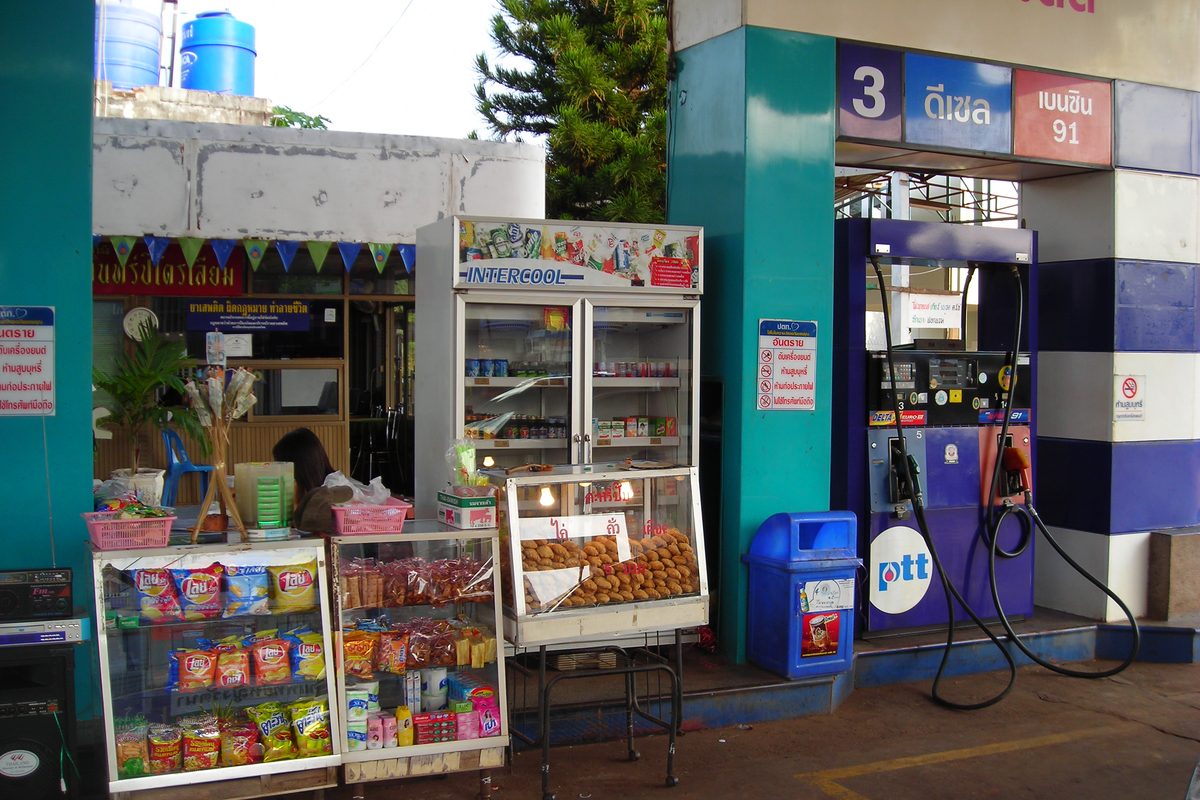
- Diesel is always clearly separated. Every station in Phuket — PTT, Bangchak, Shell, Caltex, and the smaller independent brands — labels its diesel pumps distinctly, usually with a different color scheme (often green or black) and Thai/English signage reading "ดีเซล" or "Diesel." Rental scooters are gasoline engines, so this pump is never the one you want.
- Look for the Gasohol 91 / 95 label. These are usually the pumps closest to the entrance or the most numerous on the row, since they're the most commonly used fuel by scooters, motorbikes, and most passenger cars.
- If in doubt, ask. Staff at every major station are used to tourists asking "gasohol, please" and will point you to the correct nozzle without hesitation. It's a completely normal question and nobody will think twice about it.
- Check the nozzle color, not just the pump. At some stations, multiple grades are dispensed from pumps that look similar at a glance, so a quick glance at the printed label above the nozzle before you start filling is worth the extra five seconds.
Once you've filled up at one or two stations, this becomes completely automatic, and most riders stop thinking about it after their first or second refuel.
Where to Refuel: Major Brands vs. Roadside Stalls
Major Fuel Stations
Phuket has a solid network of proper fuel stations from the major Thai brands: PTT, Bangchak, Shell, and Caltex. These are concentrated along the main roads — Thepkrasattri Road, Chalong Circle, the Bypass Road, and the routes connecting the west coast beaches — and are especially dense around the busy south and central parts of the island near Patong, Karon, Kata, and Chalong. They offer:
- Long daily opening hours, often extending well into the evening
- Accurate metered pumps with a visible price board so you always know the rate per liter before you fill up
- Acceptance of both cash and cards, useful if you're low on baht
- Convenience stores, restrooms, and sometimes food stalls attached, making them a natural rest stop during a longer ride
These stations are your default choice whenever one is nearby. There's no real reason to look elsewhere when you're riding through central or southern Phuket, since a major-brand station is rarely more than a few minutes away.
Roadside Fuel Stalls Explained
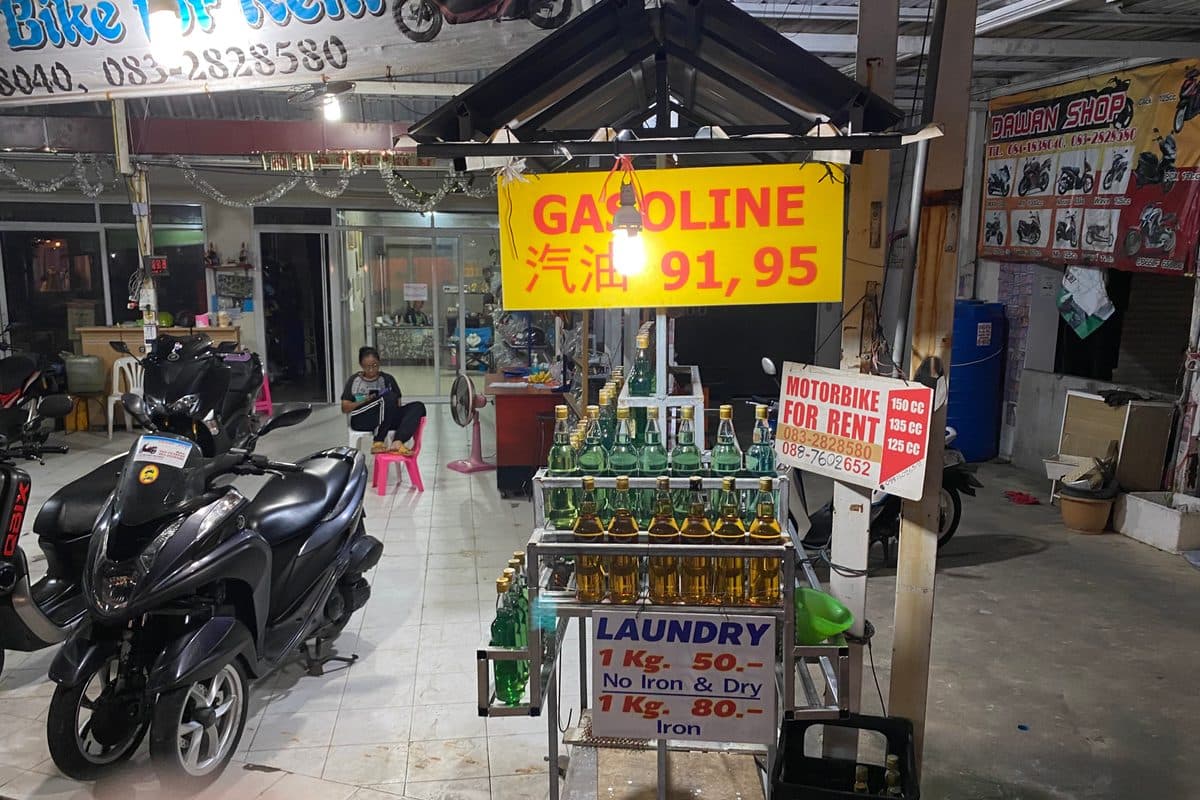
Away from the main tourist strips — particularly on smaller sois, rural back roads, and some stretches heading toward the north of the island — you'll come across small roadside stalls selling fuel out of glass bottles, sometimes old spirit or soft drink bottles repurposed for the job. These are a genuine and long-standing part of how fuel is distributed in less-trafficked areas of Thailand, and they're worth understanding rather than avoiding out of uncertainty.
- What they're good for: topping up a liter or two to get you comfortably to the next proper station, especially if your fuel light has come on unexpectedly and the nearest PTT or Shell is still some distance away.
- What to expect on price: fuel from these stalls is generally priced higher per liter than at a real station, since you're paying for the convenience of a fill-up in a location with no other fuel access nearby.
- How to use them sensibly: treat them as a stopgap, not your main refueling strategy. Buy just enough to reach the next branded station, where you can fill the tank properly at the normal rate.
- Where you'll find them: mostly in quieter residential sois, near some rural villages, and along less-developed roads where a full station hasn't been built. They're easy to spot — a small rack or table with a handful of filled glass bottles, usually right by the roadside.
There's nothing unusual or risky about buying fuel this way in a pinch; it's simply a different price point and format than a pump, and locals use these stalls regularly too.
Fuel Efficiency by Bike Class
How often you need to think about refueling depends heavily on which bike you've rented. Our fleet spans from small 110cc automatics up to larger 350cc touring machines, and fuel consumption scales with engine size and riding style.
Small Scooters (110–125cc)
Models like the Honda Scoopy and Honda Click 125i are built for efficient, everyday city and beach-road riding. These engines sip fuel, and a full tank often lasts several days of normal use — running errands, beach hopping, and short trips around town. If your plans are mostly local, you may only need to refuel once every few days, which makes the small stalls even more of a non-issue, since you'll rarely be caught with an empty tank far from a proper station.
Mid-Size Bikes
Stepping up in engine size brings more power and comfort for longer rides but also increases fuel use somewhat compared to the smallest scooters. These bikes are a good match for riders planning day trips across the island rather than just short local hops.
Larger Touring Bikes (up to 350cc)
At the top of the fleet, bikes like the ADV 350 and Forza 350 are built for comfort, highway speed, and longer-distance touring, and they naturally use more fuel per kilometer than a 110cc scooter. If you've rented one of these for a full-island loop or a multi-day tour, it's worth budgeting for more frequent stops and keeping an eye on the gauge rather than assuming the same range as a small scooter.
For more detail on which engine size suits your trip, see our guide to choosing the right bike model.
Checking the Fuel Gauge at Pickup
Before you ride off from any of our five locations — Phuket Airport, Bangtao, Chalong, Phuket Town, or Mai Khao — take thirty seconds to check the fuel level on the dashboard. It's a simple habit that avoids two common headaches:
- Knowing your starting point. If you know roughly how much fuel is in the tank when you leave, you can better judge when you'll next need to stop, especially on smaller scooters where the gauge can be a simple bar display rather than a precise reading.
- Avoiding confusion later. If anything about the fuel level looks off or you have questions about which fuel type your specific model takes, it's far easier to ask our staff at the counter during pickup than to guess later on the road.
All our locations are open daily from 09:00 to 19:30, so there's always a team member on hand at handover to answer quick questions like this before you head out, whether you're picking up from the airport counter for a trip straight into town, or from Bangtao before a beach day.
Planning Fuel Stops for Island Touring
If you're planning a longer ride — a full loop of the island, a trip up toward the north, or a day exploring viewpoints and beaches beyond your usual radius — a little fuel planning goes a long way, particularly because station density isn't the same everywhere on Phuket.
South and Central Phuket
Around Patong, Karon, Kata, Chalong, and Phuket Town, major stations are frequent and easy to find. You genuinely don't need to plan ahead here; a PTT, Shell, Bangchak, or Caltex is rarely far from any main road, and you can refuel opportunistically whenever it's convenient.
North Phuket and Mai Khao
The northern part of the island, including the area around Mai Khao, is more spread out, with fewer stations along the way compared to the busy south. If your route takes you north — toward the airport, Sarasin Bridge, or the quieter northern beaches — it's worth topping up before you head that direction rather than waiting until the gauge is low. This is exactly the kind of stretch where a roadside stall selling bottled fuel can be a useful backup if you've misjudged your range, but it's better to avoid needing one by filling up at a proper station beforehand.
General Touring Tips
- Fill up before setting out on any route that takes you away from the main tourist areas, even if the tank isn't empty yet.
- Keep in mind that hillier routes and higher speeds burn more fuel than flat, slow city riding.
- If you're touring with a larger-engine bike from the fleet, budget for more frequent stops than you would with a small scooter.
- Combine your fuel stop with a break — most major stations have a convenience store, so it's a natural place to grab water and check your route.
For safety context on some of the more remote or technical roads you might encounter while touring, our guide on dangerous roads in Phuket is worth a read alongside this one.
What If You Run Low or Run Out?
If your fuel gauge is getting low and you're not sure where the next major station is, the roadside glass-bottle stalls covered above are a legitimate way to add a liter or two and buy yourself the range to reach a proper pump. If you do run out completely, or if something else goes wrong with the bike, our guide on what to do if your bike breaks down covers the steps to take and how to reach us for support.
Frequently Asked Questions
Does it matter if I use Gasohol 91 or Gasohol 95?
No — both are regular unleaded grades and either works fine in a standard rental scooter engine. You don't need to stick to one grade consistently; use whichever is available at the station you're at.
Can I accidentally put diesel in a rental scooter?
It's very unlikely if you check the pump label first. Diesel pumps at every station in Phuket are clearly separated and labeled differently from the gasohol pumps, often with a distinct color and signage. Just take a moment to confirm you're at a gasohol pump before filling up.
How often will I need to refuel a small scooter?
A small 110–125cc scooter like a Scoopy or Click 125i is efficient enough that a full tank often lasts several days of normal riding around town and the beaches, so most renters only refuel every few days rather than daily.
Are the roadside fuel stalls safe to use?
Yes, they're a normal and long-standing part of how fuel is sold in rural parts of Thailand. They're best used for topping up a small amount to reach a proper station rather than as your main fueling source, and they typically cost more per liter than a branded pump.
Do fuel stations in Phuket accept cards?
The major brands — PTT, Bangchak, Shell, and Caltex — accept both cash and cards. It's still sensible to carry some cash as a backup, especially at smaller stations or roadside stalls.
Is fuel harder to find in any part of the island?
The north of Phuket, including the area around Mai Khao, has fewer stations spread over a larger area compared to the busy south and central zones. Top up before heading north rather than relying on finding a station along the way.
Will a bigger bike like the ADV 350 use a lot more fuel than a scooter?
It will use more fuel per kilometer than a small 110–125cc scooter, since it's a larger engine built for touring and highway speeds. It's not something to worry about, just something to budget slightly more frequent stops for on longer rides.
What should I do at pickup regarding fuel?
Take a moment to check the fuel gauge on the dashboard before riding off from any of our five locations, and ask our staff at the counter if you have any questions about the fuel type for your specific model.
Ready to rent a bike? Choose a motorbike from our fleet!
Go to Fleet